 EN
EN


Typical Controllable Distance Benchmarks for Industrial Wireless Remote-Controlled Loaders
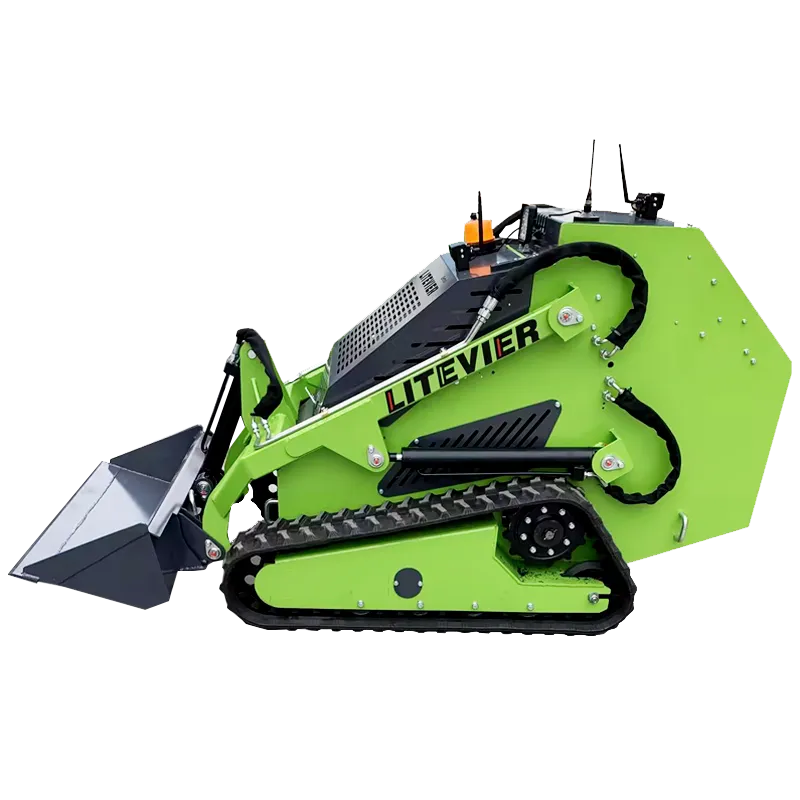
Standard range specifications across OEMs and industry standards
Industrial wireless remote-controlled loaders typically advertise operational ranges between 500–5,000 meters under ideal conditions. Most manufacturers cite 2,000–3,000 meters as the practical benchmark for open-field environments—though real-world performance consistently falls short due to environmental and technical constraints. Key factors shaping these metrics include:
- Frequency band implementation: 433 MHz systems deliver ~30% greater effective range than 2.4 GHz alternatives in obstructed or industrial settings
- Signal modulation: FHSS (Frequency-Hopping Spread Spectrum) improves reliability by 40% over fixed-frequency systems, especially amid interference
- Environmental certification: IP67-rated transmitters sustain functionality in dust, moisture, and vibration—conditions where non-rated units fail prematurely
According to the Industrial Wireless Report 2023, only 15% of deployed sites achieve manufacturer-stated maximums; the median real-world distance across diverse industrial terrain is 1,200 meters.
Shandong Songsheng Heavy Industry’s published range data and real-world validation
The 20 to 45 percent drop we see is pretty standard for signal loss when signals hit buildings or other physical barriers. Songsheng developed their own special antenna setup which actually works about 18% better at getting through trees and bushes compared to regular antennas. Still, those metal structures everywhere really mess with the signal quality. Independent tests have shown something interesting too: if someone wants to keep using the system past 2500 meters away, they need a clear path with nothing blocking it. And let's face it, places full of interference such as old factories with lots of machinery or electrical substations cut down the working distance quite dramatically, sometimes under 800 meters in practice.
Key Technical and Environmental Factors That Limit Wireless Remote-Controlled Loader Range
Line-of-sight dependency and signal attenuation from obstructions
RF communication works best when there's nothing blocking the path between the sending device and receiving end. Things like concrete walls, metal frames, or piles of stuff can really mess with the signal strength, cutting down how far it reaches by as much as two thirds compared to what happens in wide open spaces. Lower frequency signals around the 433 MHz range tend to get through obstacles better than those at higher frequencies, but even so, thick or metallic materials will still soak up or bounce back a lot of that radio wave energy. For anyone working with these systems, keeping things visible between transmitter and receiver is pretty important if they want to avoid getting cut off right when they need reliable connection most.
EMI, terrain, weather, and frequency band (e.g., 433 MHz vs. 2.4 GHz) effects
Four environmental variables critically constrain controllable distance:
- EMI Interference: Arc welders, variable-frequency drives, and high-current switching gear emit electromagnetic noise that disrupts command integrity
- Terrain: Slopes, depressions, and metallic-rich soils create signal shadows and absorption zones
- Weather: Humidity alone can reduce range by 15–30%; rain and snow exacerbate scattering and path loss
- Frequency Tradeoffs:
Selecting the optimal frequency band requires balancing site-specific interference profiles, structural density, and control responsiveness requirements.
Hardware Foundations: How Transmitter Power, Receiver Sensitivity, and Antenna Design Define Maximum Range
The maximum controllable distance of a wireless remote-controlled loader is determined by three interdependent hardware elements: transmitter power, receiver sensitivity, and antenna design. Together, they define the system’s link margin—the buffer between transmitted signal strength and the minimum level the receiver needs to decode commands reliably.
The power level of a transmitter, measured in milliwatts, has a direct impact on how far the signal can travel. For instance, a 100 mW transmitter generally covers much more ground than something with just 10 mW power. But going too high with the output isn't always wise either. Higher power drains batteries faster and might actually run afoul of regulations in certain areas. Now when it comes to receivers, their sensitivity matters a lot too. This is usually given in dBm measurements. The lower the number, the better the performance. Take for example a receiver rated at -120 dBm versus one at -90 dBm. The former will keep working reliably even when signals get weak, especially important in places full of electrical interference where weaker receivers tend to drop connection completely.
Antenna design acts as the critical interface between electronics and RF propagation. Its performance hinges on three attributes:
- Gain (dBi): Higher-gain antennas focus energy directionally, boosting effective range along a primary axis
- Radiation pattern: Omnidirectional antennas support flexible operator movement; directional types maximize reach toward fixed work zones
- Resonant frequency alignment: Antennas tuned precisely to the operating band (e.g., 433 MHz) minimize impedance mismatch and insertion loss
When optimized in concert—high-efficiency transmission, deep-sensitivity reception, and purpose-built antenna geometry—these components enable reliable control over 500+ meters in open terrain. Real-world deployment, however, introduces attenuation that demands careful system-level calibration.
Practical Strategies to Maximize and Stabilize the Controllable Distance of Your Wireless Remote-Controlled Loader
Optimizing Antenna Placement, Shielding, and Site-Specific RF Configuration
Three targeted hardware interventions significantly improve both range stability and operational resilience:
First, antenna placement must avoid coupling with conductive surfaces: mount antennas at least 50 cm from metal structures and elevate them 3–4 meters above ground level to reduce multipath distortion and ground-plane absorption.
Second, EMI shielding is essential near high-noise sources such as motors, inverters, or control cabinets. Grounded metallic enclosures around receivers—and shielded cabling for internal connections—suppress disruptive noise without compromising signal fidelity.
Third, setting up RF configurations for specific sites leads to better performance. Check if 433 MHz actually works better through walls and structures compared to 2.4 GHz in the actual layout of the building. Also adjust transmitter power according to how the land looks around it, not just going for maximum range numbers. The manufacturers say when these three approaches are used together, they help maintain control distances even in tough industrial environments where there are lots of concrete walls and metal structures getting in the way. This makes sense because real world conditions rarely match ideal lab settings.
FAQ
What is the typical range for industrial wireless remote-controlled loaders?
Typical ranges for these systems are advertised between 500 and 5,000 meters, with most manufacturers citing 2,000-3,000 meters as practical benchmarks under ideal conditions.
How does frequency band affect the range of these systems?
Frequency bands like 433 MHz offer superior obstacle penetration and longer wavelengths, translating to a greater effective range in obstructed settings compared to 2.4 GHz systems.
Why doesn't real-world performance often reach manufacturer-stated ranges?
Factors such as environmental obstacles, signal interference, and technical constraints cause real-world ranges to fall short of manufacturer-stated maximums.
What role does antenna design play in signal range?
Antenna design is crucial for focusing energy directionally, supporting operator movement, and ensuring efficient RF propagation to optimize control distance.
Table of Contents
- Typical Controllable Distance Benchmarks for Industrial Wireless Remote-Controlled Loaders
- Key Technical and Environmental Factors That Limit Wireless Remote-Controlled Loader Range
- Hardware Foundations: How Transmitter Power, Receiver Sensitivity, and Antenna Design Define Maximum Range
- Practical Strategies to Maximize and Stabilize the Controllable Distance of Your Wireless Remote-Controlled Loader